
| By TruLight of the Midlands
There is no single outdoor lighting cost that fits every home. A few lights along an entry walk, a layered landscape design, security-focused lighting, and permanent roofline lighting use different equipment and solve different problems. Your first budget decision is choosing which result matters most.
This guide helps you build a realistic starting scope before you ask for prices. If you already know the layout you want and need help comparing line items, read our separate guide to outdoor lighting installation cost. If you are still deciding what belongs in the plan, begin with TruLight’s outdoor lighting service.
The short answer: define the result before the budget
A broad national average mixes product-only kits, small low-voltage projects, permanent systems, electrical work, and full-service installations. That number cannot tell you what your home will cost because it does not know which areas matter, how they will be reached, or what equipment is already available.
A better starting point is one plain-language sentence: “I want the walk from the driveway to the front door to feel easier to navigate,” or “I want the front roofline to have warm-white light most nights and color for holidays.” That outcome gives an installer something specific to design and price.
First, decide which kind of outdoor lighting you are pricing
Entry, path, and security-oriented lighting
This type of plan focuses on steps, walks, driveways, doors, gates, or darker side-yard routes. The budget may include path, step, wall-mounted, area, or motion-responsive lighting, plus the wiring and controls needed to operate those zones. The goal is useful visibility with thoughtful placement—not simply making the whole yard brighter.
Landscape and outdoor-living lighting
A landscape plan may combine path lights, accent fixtures, tree lighting, patio or porch lighting, and separate control zones. Fixture purpose matters more than a raw fixture count: one light may guide movement, another may show the texture of a tree, and another may add comfortable light near a seating area. Our landscape lighting cost guide goes deeper into transformers, wire routes, aiming, and maintenance.
Permanent roofline and architectural lighting
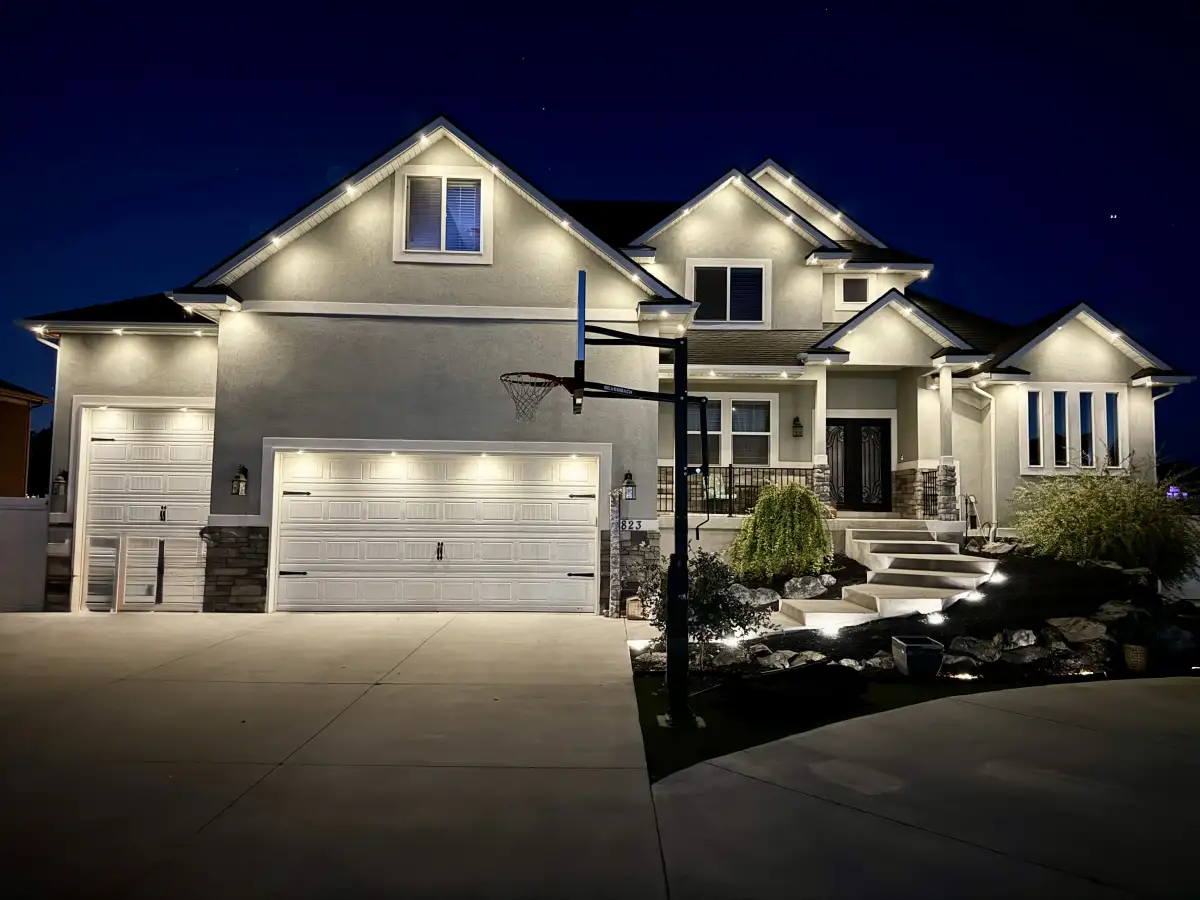
A permanent lighting budget is usually organized around measured roofline coverage, height, peaks, gables, mounting details, power, controller placement, and app zones. A front elevation can be a complete first phase. Wrapping side elevations, garage returns, porches, or additional peaks expands the scope.
A whole-home combination
You may want roofline curb appeal, a clearer route to the door, and light around a patio or planting beds. These goals can share one property-wide plan without becoming one undifferentiated number. Ask for the proposal to separate each area or system so you can see what belongs in the first phase and what can wait.
Use three questions to set a first-phase budget
Before choosing fixtures or controls, walk outside after dark and answer these questions:
- Which route or view matters every night? Start with the front walk, driveway arrival, main entrance, street-facing roofline, or outdoor-living area you use most.
- What problem should the light solve? Name curb appeal, easier navigation, outdoor use, seasonal color, or a specific darker area. Each goal calls for a different layout.
- What can become a later phase? Separate the must-have result from tree accents, secondary paths, side elevations, extra zones, or other additions that do not need to happen now.
This approach protects the design better than buying the maximum number of inexpensive lights. One complete, well-aimed arrival route or front elevation is more useful than thin coverage spread across every edge of your home and yard.
What belongs in the total cost of ownership?
The purchase and installation total is only the first line in an outdoor lighting budget. Ask how the system will be used and serviced after the work is complete.
- Electricity: operating time, brightness, fixture type, and the number of zones all affect use.
- Cleaning and aiming: landscape fixtures can collect debris or shift as soil, mulch, yard work, and weather affect the area around them.
- Plant growth: shrubs and trees change the beam path over time, so some fixtures may need to be moved or redirected.
- Connections and components: ask how fixtures, wiring connections, transformers, controllers, and individual lighting sections can be accessed for service.
- Control support: for app-connected systems, keep the controller location, network details, zone names, and service contact with the owner information.
South Carolina Midlands homes also contend with humid weather, storms, fast-growing vegetation, drainage patterns, and active yard maintenance. Those conditions make sensible fixture placement, protected connections, and service access part of the value—not details to consider only after a problem appears.
How to compare prices without losing the plan
Ask each provider to price the same written outcome. The proposal should identify the areas being lit, equipment or fixture types, power and wiring plan, controls, installation work, setup, exclusions, and service terms. If one total includes three zones and another includes one, the lower number is not necessarily the better price.
Be cautious when a proposal does not define endpoints, assumes existing power will work without review, prices only by fixture count, or leaves future maintenance and service unexplained. A clear quote does not need to be complicated, but it should tell you what will look and work differently when the installation is finished.
When phasing helps—and when it can cost more
Phasing is useful when each stage delivers a complete result. An entry and arrival route can stand on its own. So can a front roofline, a patio zone, or front-yard focal points. The first design should still consider future transformer or controller capacity, wire routes, zone organization, and connection points.
Phasing becomes less efficient when later work requires reopening hardscape, replacing undersized equipment, rerouting finished wiring, or rebuilding controls that were never planned to expand. You do not need to buy every phase now, but it helps to identify likely additions before the first installation begins.
Outdoor lighting cost questions for Camden and Midlands homes
How much should I budget for outdoor lighting?
Set the budget after defining the kind of lighting, the must-light areas, the controls you need, and whether the work will happen at once or in phases. A focused entry, a landscape plan, and a permanent roofline system are different projects, so a broad national average is not a reliable budget for your home.
What is a good rule of thumb for outdoor lighting?
Light the route or feature you need without trying to make every surface equally bright. Start with entries, steps, walkways, or the main view of your home, then add accent or gathering-area lighting only where it improves use, visibility, or curb appeal.
Do I need an electrician for outdoor lighting?
It depends on the equipment and electrical work involved. New circuits, outlets, panel changes, and line-voltage fixtures may require a properly qualified electrical professional and local permits or inspections. Ask the lighting provider to identify the power plan and who is responsible for each part.
How can I lower outdoor lighting cost without getting a weak design?
Prioritize one complete result instead of spreading a small amount of light across the whole yard. Begin with the entry and arrival route, one street-facing elevation, or one outdoor-living area, and make sure the first phase leaves a sensible path for later expansion.
What ongoing costs should I plan for?
Plan for electricity, occasional cleaning and aiming, vegetation growth around fixtures, troubleshooting, and eventual component service or replacement. Ask how fixtures, wiring connections, controllers, and app access are serviced before accepting the initial quote.
Turn your priorities into a property-specific quote
TruLight serves Camden and communities throughout the South Carolina Midlands service area. When you reach out, describe the first route, view, or gathering area you want to improve and whether you are considering one complete project or a phased plan.
Contact TruLight of the Midlands to discuss your outdoor lighting priorities and request a quote tied to your home.